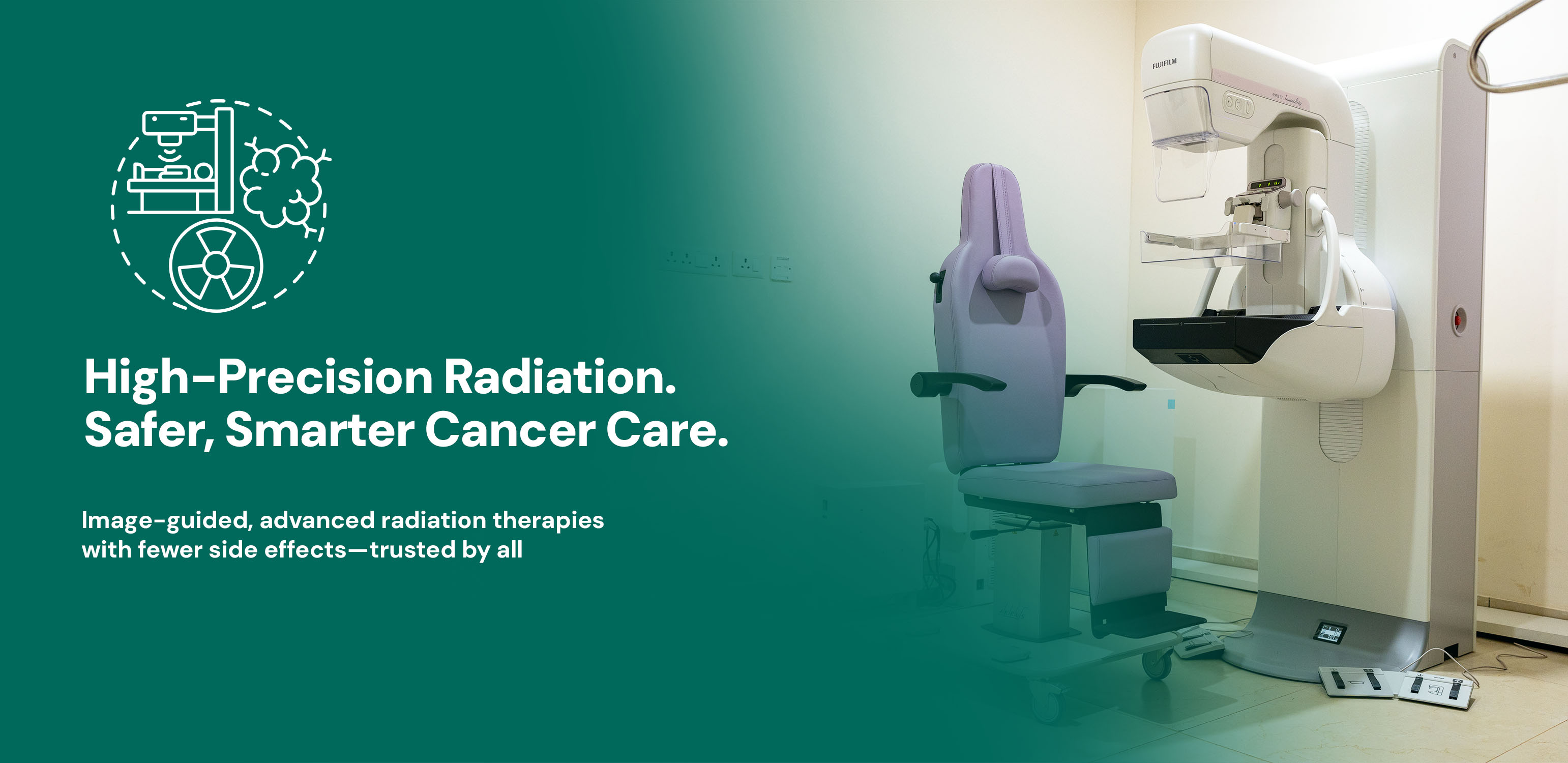
The Radiation Oncology Department specializes in using powerful, precisely targeted doses of high-energy radiation to destroy cancer cells and shrink tumors. Our approach is defined by precision, utilizing advanced technologies like IMRT, SBRT, and Brachytherapy to maximize the dose delivered to the cancer while rigorously sparing surrounding healthy tissue. As a key component of the multidisciplinary team, we offer personalized treatment plans that adhere to the strictest global standards set by International Regulatory Organizations.
Our department's mission is to provide expert, compassionate care through the controlled and precise delivery of therapeutic radiation. Radiation therapy works by causing damage to the cancer cells' DNA, rendering them unable to grow or multiply. This treatment is versatile, serving multiple critical functions in cancer care:
For many localized cancers (e.g., prostate, lung, cervical or head & neck cancers), radiation is used as the primary, stand-alone treatment with curative intent.
We work closely with Surgical and Medical Oncology, using radiation before surgery (neoadjuvant) to shrink large tumors, or after surgery (adjuvant) to eliminate any remaining microscopic cancer cells.
Radiation can be used effectively to relieve pain, stop bleeding, or reduce pressure caused by tumors that have spread (metastases), significantly improving patient comfort and quality of life.
Our radiation oncologists specialize by disease site (e.g., Breast, CNS, GI, GU, Lung), ensuring you receive treatment from an expert focused solely on your specific cancer type.
We offer a full spectrum of advanced external and internal radiation modalities, allowing us to tailor treatment to the unique shape, location, and stage of your tumor.
Delivers extremely high, ablative doses of radiation with pinpoint accuracy in a minimal number of fractions (typically 1–5). Used for small, well-defined tumors in the lung, liver, spine, brain or sites non easily accessible for conventional treatments.
The Non-Invasive Knife: This is a non-surgical treatment that delivers a single, powerful burst of radiation (or a few highly focused beams) directly to a small tumor, often achieving results similar to surgery without the incision or recovery time.
IMRT shapes the radiation beams to match the 3D contour of the tumor, varying the dose intensity across the target. IGRT uses daily imaging (CT or X-ray) on the treatment machine to confirm the tumor's exact position before each treatment.
Daily Precision Check: We use advanced computer planning to mould the radiation beam perfectly around your tumor, protecting organs nearby. We then use daily pictures (imaging) to confirm the tumor hasn't shifted, ensuring the beam hits the target every single time.
Involves placing sealed radioactive sources temporarily (High-Dose Rate, HDR) or permanently inside the body directly at or near the tumor site. Commonly used for prostate, gynecological, and breast cancers.
Up-Close Treatment: Instead of shooting the beam from outside, the radiation source is placed inside the body, right next to the tumor. This delivers a very high dose exactly where it's needed, protecting surrounding healthy tissue.
We utilize the latest linear accelerators (e.g., TrueBeam, Halcyon) and treatment planning software to optimize dose distribution. Our integration of IGRT and 4D CT simulation accounts for tumor movement during breathing, ensuring unparalleled sub-millimeter accuracy.
Our board-certified radiation oncologists are organized into specialty teams (e.g., Lung Cancer Team, Prostate Cancer Team). This focused expertise ensures that your personalized plan benefits from the collective knowledge and experience concentrated on your specific disease.
Our radiation oncologists are fully integrated into our hospital's multidisciplinary Tumor Boards. Every patient's plan is reviewed by the surgeon, medical oncologist, and radiation oncologist, ensuring a unified approach consistent with global standards and International Guidlines.
Our commitment to research provides eligible patients with access to cutting-edge clinical trials, investigating new combinations of radiation with Immunotherapy or novel drug sensitizers for the most difficult cancer problems.
Beyond technology, we provide comprehensive Supportive Care Services including patient navigators, pain management, nutritional counseling, and behavioral health, recognizing that treating the patient is as important as treating the disease.

MBBS, DMRT - Radiotherapy (1974), MD (RT) - Radiotherapy (1975)
Senior ConsultantRadiation Oncology

MBBS, DMRT (1985), MD - Radiotherapy (1988), DNB - Radiotherapy (1992)
Senior Consultant & HODRadiation Oncology
MBBS, MD - Radiotherapy (2008), DNB - Radiotherapy (2010), PGDMLS
Senior ConsultantRadiotherapy

MBBS, MD (Radiotherapy)
ConsultantRadiation Oncology

MBBS, MD - Radiation Oncology (2020), DNB (Radiotherapy)
ConsultantRadiation Oncology